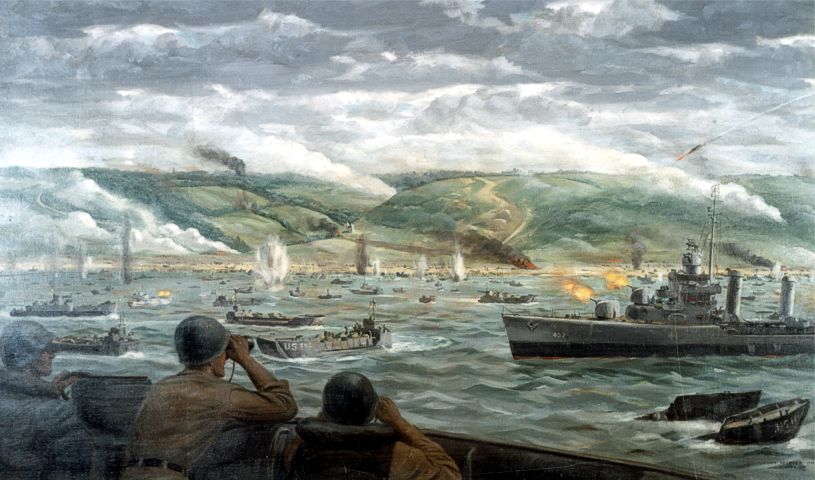
Edited by Destroyer History Foundation from Naval Historical Center photo 19-K-N-570. “The Battle for Fox Green Beach” by Dwight Shepler #146, 1944: oil on canvas showing Emmons bombarding German positions covering the eastern sector of Omaha Beach, Normandy, 6 June 1944. American forces fought all day for this stretch of Omaha beachhead. Its benign green bluffs and valley entrance were a maze of crossfire from enfilading German 88mm guns, mortars and machine guns, which raked the beaches and pinned down the infantry in a small area before expertly-placed minefields. By mid-afternoon, disabled landing craft were clogging the few gaps in the beach obstacles, while under a rain of short and long-range artillery fire, support waves circled and jockeyed for an opening. Destroyers moved toward the beach in shoal water to pump salvos of 5-inch shells into stubborn German emplacements and mobile targets of opportunity. The house in the valley and the spire of Colleville-Sur-Mer’s Church of Notre Dame on the hill were landmarks of Fox Green Beach. Germans used the spire as an artillery control tower, with spotters able to see the full panorama of the American forces and direct artillery fire at opportune targets. The church’s lovely renaissance architecture crumbled into sad rubble when a US fire-control party on the beach called on Emmons to demolish it. It was this beach that Hemingway described in his article “Voyage to Victory.” Caption source: Naval Historical Center. |